OOPBUY parcel consolidation is not a rule that says “put everything in one box.” It is a comparison. You are deciding whether several warehouse items should share one international shipment or be separated into parcels with different route, timing or protection needs. Combining can remove repeated outer packaging and may reduce repeated base charges, but it can also create a larger box, eliminate eligible lines or make one difficult item control the whole shipment. The right answer comes from the current parcel data—not a universal kilogram target.
01 · Define the decision correctly
What OOPBUY parcel consolidation actually means
OOPBUY’s public product pages describe a two-stage payment flow: the buyer pays for goods first and international shipping later. They also show estimated item weight, estimated dimensions, warehouse arrival and QC-photo fields. That separation matters. Product orders can arrive from different sellers at different times, while the international parcel is planned after the selected goods reach the warehouse.
In practical terms, consolidation means selecting more than one warehouse item for the same outbound parcel. Splitting means creating separate parcel groups. The currently visible public pages do not establish a universal consolidation discount, a fixed “best” parcel weight or a guaranteed saving. Any guide that promises one number for every destination is skipping route-specific pricing, package dimensions and item restrictions.
The useful question is therefore not “Is consolidation cheaper?” It is: “For these approved items, to this destination, with today’s eligible routes and final packing choices, does one parcel create a better total trade-off than two?”
02 · Do not package unresolved problems
Pass the warehouse readiness gate before comparing quotes
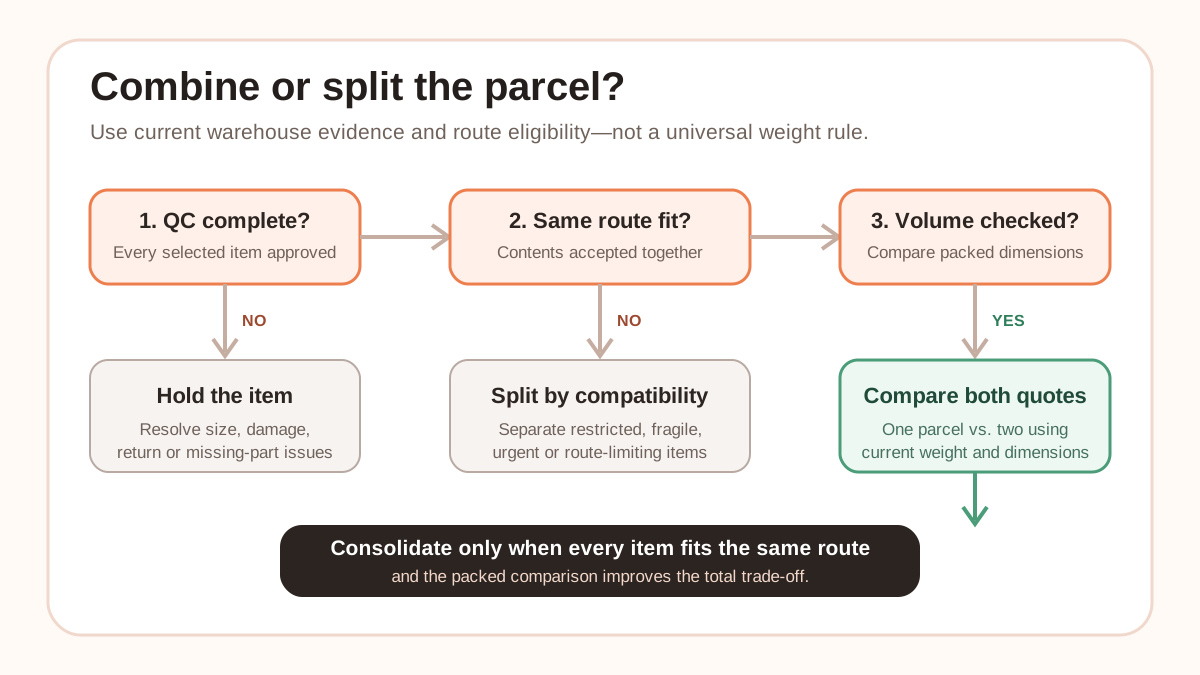
A parcel comparison is premature while one item still has an unresolved QC, size, quantity or return question. International dispatch usually makes correction far harder than action at the warehouse. Start by matching every selected item to the live order record: product identity, chosen variation, quantity, visible condition, included pieces and any measurement evidence that mattered to the purchase.
OOPBUY publicly states that items receive quality inspection after warehouse receipt and that QC photos are provided. A photo can confirm visible details, but it cannot prove hidden construction, long-term durability or authenticity. If the evidence does not answer a decision-changing question, hold that item outside the parcel until the current after-sales option is clear. Do not let a storage deadline silently make the decision for you; OOPBUY currently advertises 90 days of free storage after warehouse receipt, but the account’s live deadline remains the controlling record.
Use four parcel statuses: ready, hold for evidence, return/exchange in progress, and do not ship. Only “ready” items should enter the consolidation comparison.
03 · Separate by constraint, not superstition
When splitting an OOPBUY parcel is the smarter choice
Split first when the items do not share route eligibility. Batteries, perfume, cleaning fluids and other everyday products can fall under dangerous-goods rules; the Universal Postal Union specifically warns that such items may be restricted or forbidden in international mail. That does not tell you which OOPBUY line will accept a particular item. It tells you to check the live route screen and avoid assuming ordinary clothing rules apply to sensitive goods.
Split when one bulky item dominates the package. Carriers may bill the greater of scale weight and dimensional weight. UPS explains dimensional weight as the space a parcel occupies relative to its actual weight and notes that the applicable calculation can affect domestic and international services. OOPBUY routes are not UPS rate cards, so do not import a divisor blindly. The principle is what matters: adding a light but large product can increase chargeable size enough to change the comparison.
Split when protection requirements conflict. Soft clothing may tolerate compression; a structured bag, collector box or fragile accessory may not. Packing everything together can force either too little protection for the fragile item or unnecessary volume around the flexible items. Split when urgency differs as well. A ready item needed soon should not automatically wait for a delayed seller, while non-urgent goods may benefit from a later combined comparison.
Finally, split when one item removes the best current route for everything else. Never split parcels to misdescribe contents, evade customs rules or copy an undeclared-value tactic from social media.
04 · Compare complete scenarios
How to compare one parcel with two parcels
Build Scenario A with every ready, compatible item. Record the destination, selected contents, planned packaging, estimated or packed weight, length, width and height, eligible routes and total quoted international charge. Then build Scenario B with two logical groups. Keep the same destination and compare the combined cost of both parcels, not the cheapest individual quote.
Use current warehouse numbers where available. Seller estimates are useful before purchase; warehouse measurements are better after receipt; packed parcel measurements are the most relevant for the final quote. If OOPBUY offers a current pre-packing or rehearsal option in the logged-in interface, read its live description and price before using it. The public evidence checked for this article does not support publishing a fixed rehearsal fee or guaranteed percentage saving.
| Decision field | One consolidated parcel | Two split parcels |
|---|---|---|
| QC status | Every item must be ready | Problem item can remain on hold |
| Route eligibility | One line must accept all contents | Each group can use a fitting line |
| Chargeable basis | Check final mass and outer dimensions | Add both billable results |
| Packing | One protection plan serves mixed items | Protection can match each group |
| Timing | All items move together | Ready or urgent items can move first |
| Operational risk | One tracking chain, more value together | Two tracking chains, exposure divided |
Do not compare only freight. Include optional packing charges shown now, any repeated parcel-level fees, and the value of waiting. Because destination-side taxes and customs treatment vary, check the current local rules separately. A warehouse quote is not a guaranteed landed cost.
05 · A worked decision without invented prices
A mixed warehouse example
Imagine that three orders are ready: folded shirts, boxed shoes and a power bank. This is a hypothetical planning example, not a report of a real customer or a claim that a particular route accepts the goods.
First, confirm the shirts and shoes passed QC. Decide whether the shoe box has practical value; removing it may reduce space, but the shoes still need shape and surface protection. Treat the power bank as route-sensitive until the live system shows an eligible method. IATA identifies lithium batteries as dangerous goods subject to transport requirements, so it should not be grouped by convenience alone.
Now compare. Scenario A contains all three items and is valid only if a current route accepts the full contents. Scenario B groups the ordinary goods together and keeps the power bank separate under an eligible method—or leaves it in storage if no acceptable route appears. Scenario C compares the shirts and shoes with and without the retail box using realistic packed dimensions.
The answer can change without any product price changing. If the power bank removes ordinary-goods routes, splitting may preserve options. If the shoe box drives dimensional weight, a different packing request may matter more than splitting. If the full parcel remains eligible, compact and adequately protected, consolidation may be the cleaner choice. This method produces a decision you can audit without inventing a “sweet spot” weight.
06 · Submit only the parcel you compared
OOPBUY warehouse consolidation checklist
- Mark each item ready, on hold, in after-sales, or excluded.
- Verify size, color, quantity, visible condition and included pieces.
- Use the real destination and the account’s current warehouse records.
- Separate route-sensitive goods before assuming one line fits everything.
- Compare one-parcel and two-parcel scenarios using complete totals.
- Enter realistic dimensions; do not treat scale weight as the only input.
- Check whether one bulky item controls the outer carton.
- Match packaging to compression, structure and fragility needs.
- Read current route restrictions, charging rules and protection terms.
- Keep parcel screenshots, payment records and tracking until delivery is complete.
After submission, preserve the final contents list, packed measurements, route name, declared information and tracking number. If the final charge differs materially from your earlier estimate, compare the recorded weight, dimensions, packing and route rather than guessing. That evidence is also what makes a support request specific.
Verifiable evidence record
Sources, scope and limitations
Official pages establish what OOPBUY displayed on the check date, not an independent guarantee. Carrier and postal sources explain general transport rules, not the price or eligibility of a specific OOPBUY route.
OOPBUY
Current product pages and Proxy Shopping Guide
Show separate goods and international-shipping stages, warehouse arrival, estimated weight and dimensions, QC fields and an international shipping estimate.
Evidence type: official primary source; intentionally not linkedOOPBUY
Platform Guarantee and risk notices
State quality inspection after receipt, QC photos, 90 days of free storage and warnings that some products may face purchase or policy restrictions.
Evidence type: official primary source; intentionally not linkedUPS
Shipping Dimensions and Weight
Explains that dimensional weight reflects occupied space and may be compared with actual weight to determine billable weight.
Evidence type: carrier guidance; formulas remain service-specificUniversal Postal Union and IATA
Dangerous Goods · Lithium battery shipping guidance
Identify common dangerous goods and explain that lithium batteries are subject to transport requirements.
Evidence type: international transport guidanceNo source in this ledger supports a universal ideal parcel weight, fixed consolidation saving, guaranteed route, delivery promise or customs outcome. Check the logged-in quote and destination rules at the time of submission.