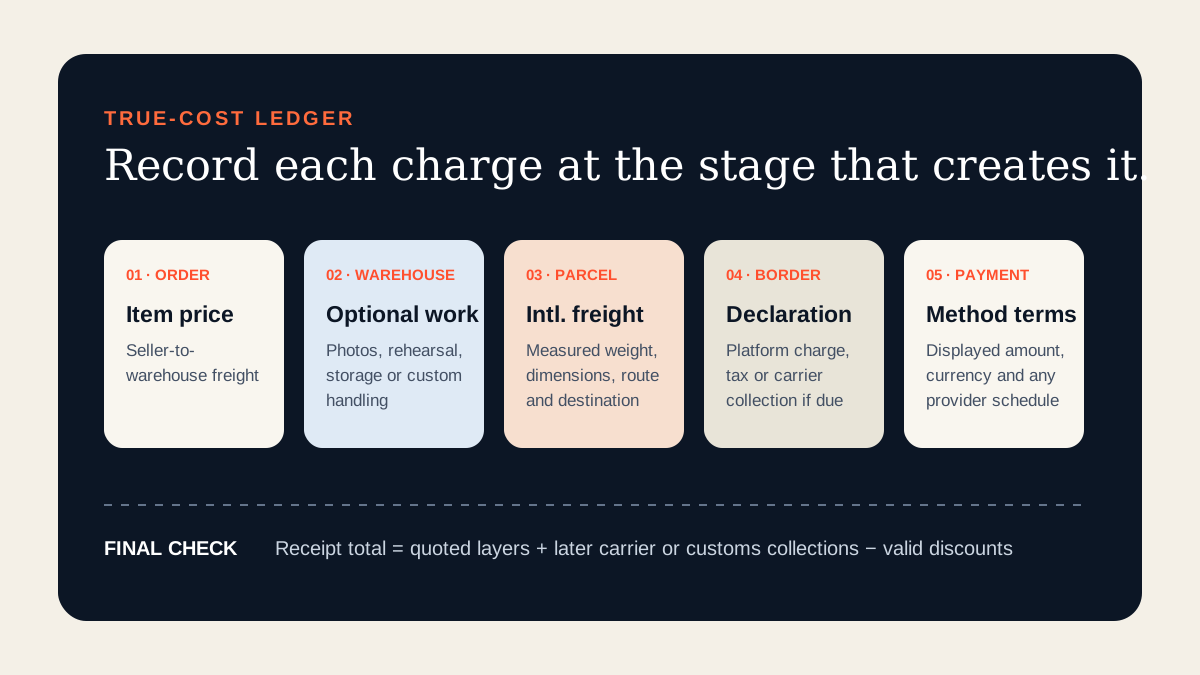
The useful answer to “What are the OOPBUY fees?” is not one percentage. A buying-agent order moves through several checkpoints, and each checkpoint can create a different charge. The seller stage has the item price and delivery inside China. The warehouse can add only the services you request. Parcel submission creates the international freight quote. Declaration and destination rules can add border costs. Finally, the selected payment method can have its own displayed currency, schedule or provider terms. Build a dated ledger from the live screens and you can compare a purchase before sunk costs make the decision harder.
01 · Start with the official scope
The direct answer: OOPBUY fees appear at different stages
OOPBUY’s current “Service & Fees” notice says the buying-agent total consists of the product cost, international shipping cost and a customs declaration fee, with value-added services purchased only as needed. It defines product cost as the item price plus freight from the seller to the OOPBUY warehouse. It defines international freight as dependent on product weight, the selected shipping method and destination. The same page says the parcel customs declaration fee is generally CNY 8, depending on the shipping method.
That published outline is a starting taxonomy, not a quote for your order. It does not tell you the current seller price, the domestic delivery amount, the packed parcel measurements, route eligibility, a destination tax assessment or the terms shown by a payment provider. Those figures must come from the live order and parcel screens. Record the time and currency beside each one.
02 · Give every charge an owner
The five layers of an OOPBUY total cost
Order layer: save the selected variant, quantity, current seller price and seller-to-warehouse freight. A marketplace listing can show a starting price that belongs to a different option. The amount attached to the actual size, color and bundle is the relevant one. Domestic freight is part of the product cost in OOPBUY’s published definition, so “free service” does not mean every seller ships to the warehouse for free.
Warehouse layer: standard receiving and inspection are different from optional work. Extra detail photos, rehearsal packing, parcel photos, storage extensions or custom handling should appear as separate decisions. Buy them only when the information or work can change the outcome.
Parcel layer: international freight is created after the destination, route and parcel characteristics are known. The shipping guide explains why scale weight and dimensions matter. A low product price cannot predict this layer, and a preliminary estimate should not be presented as a final invoice.
Border layer: distinguish the platform’s declaration-related charge from taxes or duties collected under destination rules. OOPBUY’s customs notice states that customs risks and assessments can depend on local policy and inspection. It discusses UK and EU VAT treatment and higher-value thresholds, but buyers should verify current destination rules rather than applying one country’s example everywhere.
Payment layer: use only the methods and amount displayed for the current account and checkout. A payment schedule changes cash flow; it does not reduce the merchandise, freight or customs obligation. Save the checkout currency and the provider’s repayment terms before authorizing.
03 · Compare like with like
Use a true-cost ledger instead of one headline number
| Ledger row | Where to verify it | When it becomes reliable |
|---|---|---|
| Selected item price | Live order option | Before purchase |
| Seller-to-warehouse freight | Order cost breakdown | Before or at purchase |
| Optional warehouse services | Service request and receipt | When requested |
| International freight | Current parcel route quote | After packed data is available |
| Declaration-related charge | Parcel checkout | At parcel submission |
| Destination tax or duty | Checkout, carrier or customs record | When assessed |
| Payment-provider cost | Final authorization screen | Before authorization |
For a clean comparison, write the formula with labels rather than guessing amounts: delivered-cost estimate = selected item price + domestic freight + chosen warehouse services + current international freight quote + displayed declaration charge + known tax or duty + any payment-provider cost − valid discounts. Leave an unknown as “not yet quoted.” A visible blank is safer than a confident zero.
Keep three columns: estimated, charged and refunded. Suppose a route quote changes after rehearsal packing or a seller return removes the item price but not domestic return freight. Updating the correct column preserves the history. Replacing the first estimate with the later number hides why the decision changed.
04 · Pay for information only when it matters
Optional OOPBUY services and their decision value
OOPBUY’s warehouse value-added-services notice currently lists rehearsal packing at CNY 20 per parcel and parcel photos at CNY 5 per parcel. It lists detailed photos at CNY 1 each, whether requested with the product order or after stock-in. Storage extension is listed at CNY 10 per product ID per month, available for items stored from day 60 through day 90, with a published maximum total storage time of six months. Customized warehousing is priced on inquiry.
These are dated platform statements checked on August 10, 2026, not permanent promises. Confirm the current service screen before ordering. More importantly, connect each option to a decision. A measurement photo is useful when a dimension can trigger a return. Rehearsal packing is useful when packed weight or volume can determine whether to split, remove packaging or choose a route. A parcel photo documents the assembled package but does not prove future carrier handling.
Avoid buying every option by default. Start with the ordinary QC evidence, identify the uncertainty, and buy the least expensive service that resolves it. If no new evidence could change “keep, return, combine or split,” the service may add documentation without changing the outcome.
05 · Payment timing is not a discount
Read the current payment terms separately from OOPBUY fees
OOPBUY currently publishes a Klarna information page for eligible US customers. It describes pay-in-four, longer monthly financing and pay-in-full choices, while stating that eligibility, possible initial payment, financing decisions and terms apply. Availability on a public information page does not prove the option will appear for every country, account or transaction. The final checkout is the source for the method actually offered.
If a deferred-payment option appears, compare the full repayment schedule with the amount due today. Check due dates, automatic payment source, late-fee rules, refund handling and the effect of a partial return. The US Consumer Financial Protection Bureau notes generally that many buy-now-pay-later products can charge late fees and that a linked bank may charge overdraft or insufficient-funds fees. That is general US guidance, not a statement about a particular OOPBUY transaction or a user outside the United States.
Save the authorization screen and receipt. The US Federal Trade Commission’s online-shopping guidance recommends retaining what was ordered, the date, the amount, the return policy, communications and the statement showing how payment was made. Those records make it possible to distinguish an OOPBUY wallet credit from an original-method refund and to identify a duplicate or missing charge.
06 · Decide before the expensive stage
Three buyer situations where the ledger changes the answer
One inexpensive but bulky item: the item price looks attractive, yet the parcel layer is unknown. Do not treat the order-layer subtotal as the conclusion. Check the shipping estimate, packaging options and route restrictions first; after stock-in, use measured evidence before committing to international shipment.
A mixed haul with one uncertain item: the questionable item can delay parcel submission or create return costs. Review its QC promptly and compare the evidence with the status-based return guide. Keeping a poor item merely because the first payment is already made can increase the international freight layer.
A purchase funded by installments: a smaller first payment can make the order feel cheaper, but the ledger should show the entire repayment obligation. Add expected parcel and border costs to the budget even if they will be charged later. If the full delivered estimate does not fit, changing payment timing does not repair the economics.
Set a stop rule before ordering: a maximum delivered cost, a maximum freight-to-item ratio, or a requirement that the packed quote remain below a chosen budget. The threshold is personal; the value is deciding it before warehouse and parcel costs accumulate.
07 · Before authorizing payment
OOPBUY fee checklist
- Confirm the exact variant, quantity and live seller price.
- Record seller-to-warehouse freight separately.
- Mark unknown parcel and border costs as unknown, not zero.
- Use the current destination, route, weight and dimensions for freight.
- Add only warehouse services that can change a decision.
- Confirm every service price on the live request screen.
- Separate a declaration-related charge from destination tax or duty.
- Apply coupons only after confirming eligibility and expiry.
- Read the final checkout currency and total before authorization.
- For installments, record every payment and due date.
- Save the order, service, parcel and payment receipts.
- Reconcile estimated, charged and refunded amounts independently.
The best cost estimate is not the one with the most precise-looking number. It is the one that clearly shows which figures are live, which are conditional and which have not been quoted yet. Build the ledger early, update it at warehouse and parcel milestones, and stop when the delivered total no longer supports the purchase.
Sources · checked August 10, 2026
Evidence and limits
OOPBUY — “Service & Fees” public notice
Supports the cost categories, domestic-freight definition, international-freight variables and the dated general customs declaration charge. Live checkout remains decisive.
OOPBUY — warehouse value-added-services notice
Supports the dated service descriptions and listed prices for rehearsal, parcel photos, detailed photos and storage extensions.
OOPBUY — “Customs and Taxation” public notice
Supports the distinction between declaration choices, destination taxes and customs risk. Country rules can change and require current verification.
OOPBUY — Klarna public notice
Supports the published US eligibility conditions and payment-plan descriptions. It does not prove availability for a particular user or order.
US CFPB and FTC payment guidance
Supports checking BNPL terms and retaining transaction records. It is general US guidance and does not replace provider terms or another country’s law.
Turn every quote into a dated ledger row.
Use the weight and route guide for the parcel layer, then check the consolidation decision guide before combining items.