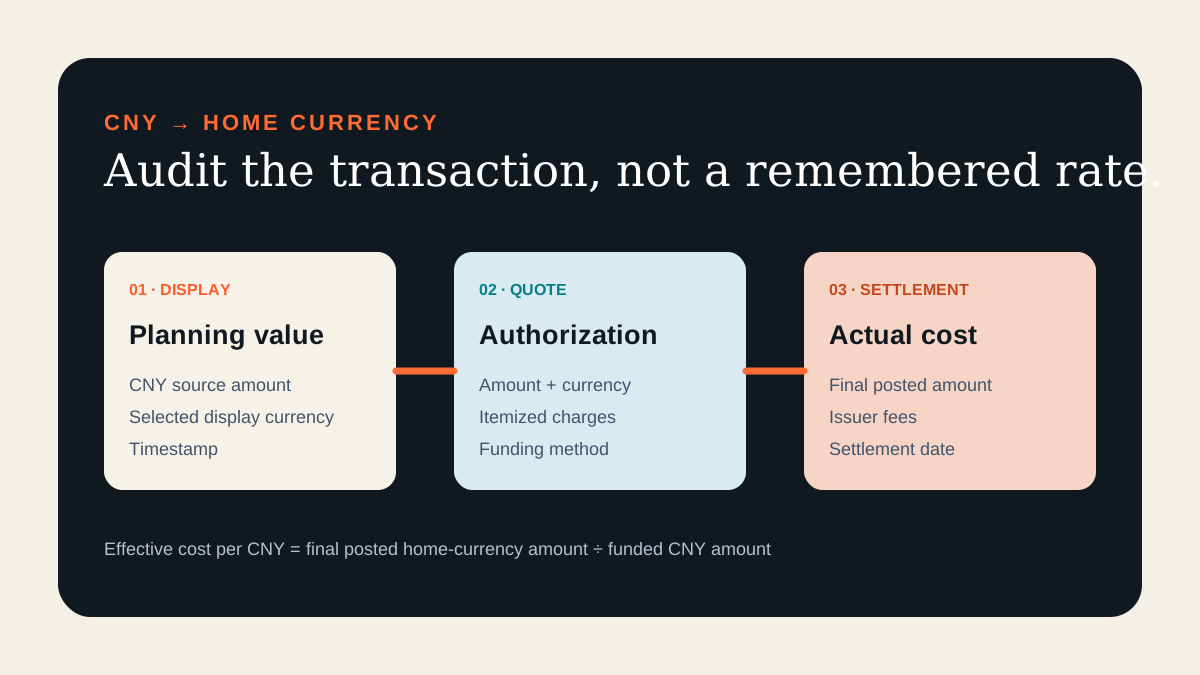
An OOPBUY exchange rate is not one permanent number. The public interface currently lets visitors display product values in currencies including CNY, USD, EUR, GBP, CAD, AUD, PLN and others, but a display conversion is not automatically the rate a bank, card network or wallet uses when money settles. Advanced cost planning therefore needs an audit trail: preserve the CNY source amount, capture the amount and currency offered at payment, then compare the final amount actually posted by the funding provider.
01 · Do not collapse the evidence
Display currency, payment currency and settlement currency are different
The first value is the display amount. OOPBUY’s current public product interface offers a currency selector and shows CNY beside converted amounts on product-discovery pages. That helps browsing, but the page does not establish that the visible conversion will be the exact payment rate. Prices, exchange rates and imported listing data can change before checkout.
The second value is the payment quote: the amount, currency and any separately disclosed charge shown immediately before authorization. It may cover a product order, a balance top-up or an international parcel, and each event can occur on a different date. The third value is the settled charge on the card, bank or wallet record. Settlement can differ from an authorization because the funding provider may apply its own conversion date, rate or foreign-transaction terms.
02 · Calculate one comparable number
Measure the effective cost per CNY
For a transaction tied to a known CNY amount, calculate: effective home-currency cost per CNY = final home-currency amount ÷ CNY amount funded. If 600 CNY of order value ultimately posts as 84 units of the cardholder’s currency, the effective result is 0.14 home-currency units per CNY. This is an illustration, not an OOPBUY quote or a current market rate. Replace both figures with your own evidence.
If the payment record contains a separately itemized fixed or percentage charge, keep that fee in its own column and calculate a second “all-in” rate including it. If the charge is not separately disclosed, do not label the full difference an OOPBUY markup. The gap may include platform conversion, processor pricing, card-network conversion, bank fees or timing. The honest label is unexplained conversion and payment difference until the responsible record identifies it.
A reference market rate can help benchmark the transaction, but it is not an invoice. CFPB guidance notes that foreign-transaction fees may involve issuers and third parties and that the rate used for a card transaction need not be the rate on the purchase date. Visa likewise describes its published card rates as indicative rather than guaranteed settlement values. Compare evidence; do not demand that every receipt equal a mid-market screenshot.
03 · Audit each payment stage
Do not average an entire haul into one hidden rate
A shopping-agent workflow can create several payment events. A product purchase may include merchandise and seller-to-warehouse freight. Later, optional warehouse services may be paid. International shipping follows after the parcel is packed, and a balance adjustment or refund may appear on another date. If these events are combined into one home-currency total, a favorable rate at one stage can hide an expensive conversion at another.
| Stage | Save before payment | Reconcile after settlement |
|---|---|---|
| Product order | CNY item value and domestic freight | Final charged amount and currency |
| Balance top-up | Quoted deposit and expected balance credit | Posted charge and credited balance |
| Warehouse service | CNY service line and quantity | Actual balance deduction |
| International parcel | Parcel quote, currency and itemized services | Final deduction or payment receipt |
| Refund | Approved CNY or balance amount | Destination, amount and settlement date |
Use one row per payment event. Attach the order or parcel number, quote timestamp, charged currency and settlement timestamp. The full OOPBUY fees ledger supplies the broader cost categories; this article isolates the conversion layer so the rate is not confused with shipping, warehouse or border costs.
04 · Compare like with like
Test payment methods with live quotes, not published assumptions
Before choosing a funding method, open the live checkout far enough to see the exact currency and amount without authorizing it. Record the same CNY target for each available method. Then check the card or wallet terms for foreign-transaction fees, currency conversion and any fixed charge. A method advertised as having no platform fee can still have conversion cost; a method with a visible fee may still produce a lower all-in settlement.
Do not compare one method on Monday with another after a rate move on Friday. Capture quotes close together and use the same order value. If one option charges directly in your home currency and another charges in CNY, note who performs the conversion. Paying in a familiar currency is convenient but does not prove it is cheaper. Conversely, choosing CNY can expose the transaction to the card issuer’s terms. The best option is the one with the lowest verified all-in result for your own account, not the one with the shortest label.
Run a small, reversible test when practical, but do not fabricate a universal percentage from it. Card product, country, payment channel and transaction date can change the outcome. Store the quoted amount, final charge and credited CNY value. Only then can the effective rates be compared fairly.
05 · Money can convert twice
Track refunds independently from the original payment
An approved refund does not automatically reverse the original currency conversion. OOPBUY’s published returns information distinguishes refund destinations and transaction stages, while the funding provider controls how an external card or wallet credit posts. A refund may first return to platform balance, or it may later reach the original method according to the applicable workflow. Confirm the destination shown for the specific transaction.
Record the original CNY value, original home-currency charge, approved refund amount, destination, credited amount and date. If the refund returns as balance, do not call it a card refund. If it reaches the original payment method, compare the credit with the settled purchase but keep exchange movement, retained charges and deductions separate. The return and refund guide explains the status and evidence path; the currency ledger explains why the final home-currency credit may not mirror the original debit.
06 · Use a three-receipt test
A practical audit example without a fictional platform rate
Suppose a planner has three genuine records: the checkout identifies 600 CNY of funded order value, the payment page quotes 82 home-currency units, and the final statement posts 84. The display-page conversion is ignored because it was never authorized. The quote-based rate is 82 ÷ 600; the settled effective rate is 84 ÷ 600. The two-unit difference is documented, but its cause remains unassigned until the checkout or issuer record explains it.
Now suppose the issuer separately lists a one-unit foreign-transaction fee. The planner can calculate an underlying settled charge of 83 and an all-in cost of 84. If no separate fee appears, the planner must not announce that OOPBUY charged two units. The correct conclusion is narrower: the final cost exceeded the pre-authorization quote, and the payment provider or platform should be asked which rate, date and fees produced the settlement.
Repeat the method for the international parcel instead of combining it with the product purchase. Different dates and amounts may produce different effective rates. This gives an advanced cost planner two useful observations rather than one misleading average.
07 · Before and after payment
OOPBUY exchange-rate audit checklist
- Preserve the product or service amount in CNY.
- Record the selected display currency only as planning context.
- Save the checkout amount, currency and timestamp before authorizing.
- Note every separately itemized payment or conversion charge.
- Check the funding provider’s foreign-transaction terms.
- Save the final posted amount rather than relying on authorization.
- Calculate quote-based and settled effective rates separately.
- Use the same CNY target and near-identical time when comparing methods.
- Keep product, top-up, service and parcel payments in separate rows.
- Do not assign an unexplained difference to one party without evidence.
- Track refund destination, amount and date as a new event.
- Recheck all live terms before the next payment.
This process cannot freeze currency markets or predict a bank’s settlement date. It does produce a reproducible answer to the question that matters: how much home currency did this exact CNY obligation ultimately cost, and which part of the difference is actually documented?
Sources · checked August 14, 2026
Evidence and limits
OOPBUY — current public product pages
Supports the current multi-currency display, CNY source values and two-stage payment workflow. Displayed conversions can change.
OOPBUY — Service & Fees public notice
Supports separating order, warehouse, parcel and payment-related costs rather than treating one converted total as a single fee.
US CFPB — foreign transaction fee interpretation
Supports separating issuer, network, third-party and merchant conversion effects and recognizing that transaction dates and rates may differ.
Visa — Foreign Exchange Rates API reference
Supports treating published card rates as indicative and potentially different from actual transaction settlement.
Measure every conversion at the transaction where it occurs.
Keep the result beside the seller-to-warehouse cost and the later parcel evidence, without merging the three stages.