OOPBUY parcel reinforcement is not automatically a bargain or a waste. OOPBUY’s current beginner guide says the warehouse can integrate and package items, reinforce the packaging, weigh the result and estimate international shipping before payment. It does not establish one permanent reinforcement price or promise that reinforcement prevents every loss. An advanced planner should therefore compare the live service quote with the parcel’s specific exposure, the extra billable weight or dimensions it may create, and the value of the damage it can realistically reduce.
01 · Start from the live parcel
Reinforcement is a service decision, not a slogan
The useful official baseline is narrow. OOPBUY’s public buying guide currently places reinforcement inside the warehouse packaging stage, before weighing and the international shipping estimate. The same guide says the estimate depends on product weight, transport method and destination, while the final charge is based on package size and weight measured by the shipping company. If the final shipping cost differs from the amount paid, OOPBUY says the difference is returned to the account after shipment.
That sequence matters. Protection can change the package that is measured. More material may add mass; a larger or more rigid outer shape may affect chargeable volume. The public guide does not publish a universal fee, material specification or guaranteed outcome for every parcel. Use the price, description and measurements shown for your parcel at submission time. Archive them before paying, because a number copied from an old guide is not evidence of today’s offer.
02 · Identify what can actually go wrong
Score exposure before buying more packaging
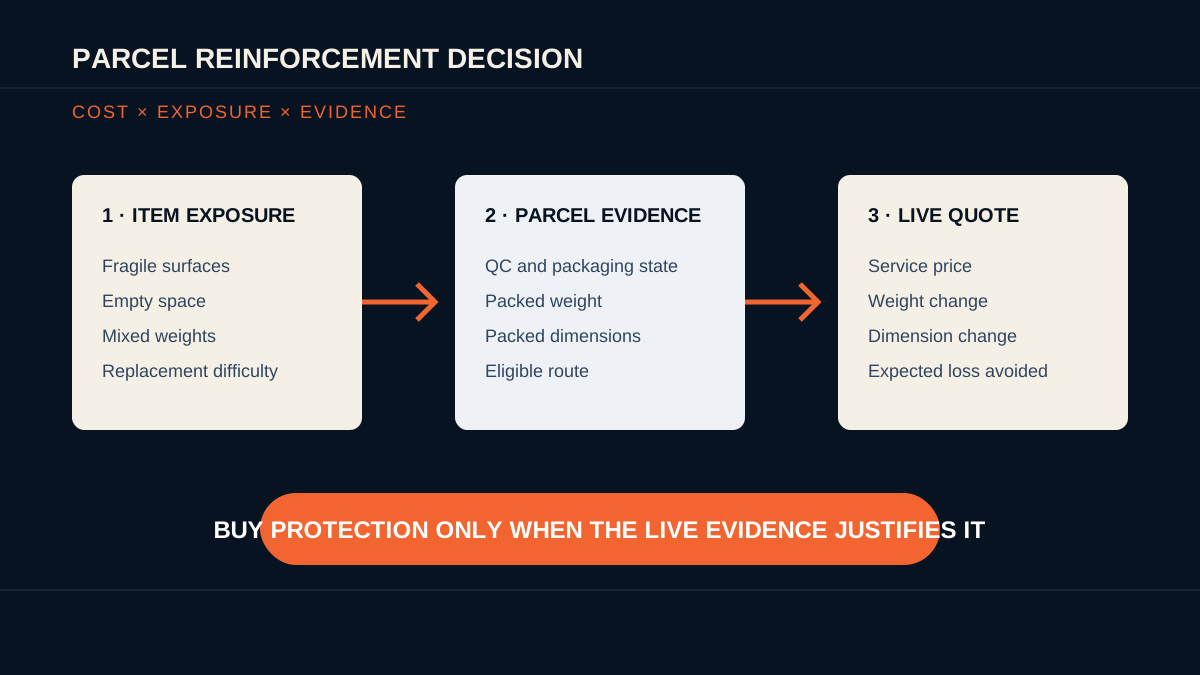
Begin with the item, not the service menu. A soft hoodie inside another parcel does not face the same compression risk as a rigid display box, a brittle decorative object or a product with projecting parts. Note four dimensions: fragility, movement, load interaction and replacement difficulty.
Fragility covers surfaces or structures that can crack, bend, crush or scuff. Movement asks whether empty space allows the item to shift. Load interaction considers what happens when a dense item shares a parcel with a light or hollow one. Replacement difficulty raises the consequence of damage when stock is limited, a return deadline has passed or seller-to-warehouse freight would be expensive to repeat.
QC photos can show visible condition before packing, but they do not prove impact resistance. Conversely, a retail box already designed for transport may provide more structure than a loose polybag. Record what the photos establish and what remains unknown. If the item already arrived crushed, reinforcement cannot reverse the damage; the right action is an after-sales decision before parcel submission. Use the QC evidence guide to separate a warehouse condition problem from a future transport risk.
03 · Count the full incremental cost
Service price is only the first line of the calculation
The reinforcement decision should use an incremental-cost model:
Total reinforcement cost = live service price + extra shipping caused by added billable weight + lost route or size advantages.
The second and third terms may be zero, but they should not be assumed away. Capture packed weight and dimensions before and after any service when the interface provides both. Then rerun the live route comparison. A small mass change may have no effect inside the same billing step, while a dimension change can matter if a line uses volumetric weight or a size ceiling. OOPBUY’s public guide confirms that final size and weight matter; it does not publish one universal divisor or route rule. Use the live eligible routes rather than importing a formula from another carrier or agent.
Next estimate the avoidable loss: probability of relevant damage × recoverable value at risk. This is a planning estimate, not a platform statistic. If a 300-CNY item has an estimated 8% exposure to the specific damage reinforcement could reduce, the gross expected exposure is 24 CNY. If reinforcement and any extra freight total 15 CNY, the comparison may favor protection. If the item is a replaceable 40-CNY textile and the service pushes the parcel into a higher billing step, it may not.
Do not treat the entire order value as automatically at risk. Some damage is cosmetic, some packaging is disposable, and some losses may be covered only under separate route or insurance terms. Reinforcement is not insurance, and insurance is not physical protection. Keep those decisions in different ledger columns.
04 · Match protection to the parcel
Four situations that produce different answers
| Parcel situation | Main question | Likely planning response |
|---|---|---|
| Soft apparel only | Is there any rigid or crush-sensitive component? | Standard packing may be enough; test whether added structure only adds chargeable size. |
| One rigid collectible box | Is the retail box itself part of the value? | Price protection around the box, not just protection of the item inside. |
| Mixed dense and light items | Can the heavy item move into the lighter one? | Consider separation, immobilization or splitting before generic outer reinforcement. |
| Several fragile pieces | Would one impact create multiple losses? | Compare item-level separation plus outer protection with a separate parcel. |
These are decision patterns, not promises about a named warehouse material. The current public guide confirms reinforcement as part of packaging, but the exact live service description controls what is actually offered. If a label does not explain whether protection is internal, external or both, ask support before paying. A vague service cannot be valued accurately.
Consolidation can change the answer. Combining items may spread a fixed service cost, but it can also create new contact points and a larger package. Splitting may isolate fragile contents while paying two base shipment charges. Run the combine-or-split decision first when parcel architecture is still flexible.
05 · Use a before-and-after record
A practical reinforcement workflow for cost planners
Before parcel submission
List every item, its warehouse condition, current packaging and the damage mechanism you want to prevent. Mark non-negotiable presentation packaging separately from disposable seller packaging. Confirm that all QC and after-sales decisions are finished. Record the planned parcel grouping and the route constraints visible for the destination.
At the live service screen
Save the reinforcement description, price, unit basis and any limitation exactly as displayed. Do not infer materials from an icon. If the screen offers notes, write the outcome you need in plain, measurable language—such as preventing a rigid box from moving against a dense item—without assuming the warehouse accepts every request. Preserve the pre-service estimate if available.
After packing
Record packed weight, dimensions, eligible routes and the actual parcel charge. Compare them with the baseline. If the selected service changes the quote, assign the difference to the parcel ledger rather than hiding it inside “shipping.” OOPBUY’s guide says the final shipping difference is reconciled after shipment, so retain the account adjustment as a separate record instead of treating the original estimate as final cost.
After delivery
Photograph the unopened outer parcel if there is visible damage, then document the internal packing and affected item. This is evidence for a support or carrier process, not proof that reinforcement failed in every shipment. Add the observed outcome to your own planning history: item type, parcel mix, service, route, packed measurements and result. Personal evidence becomes useful only when the conditions are preserved.
06 · Payment gate
OOPBUY parcel reinforcement checklist
- Confirm the item is undamaged before shipping; use after-sales first if it is not.
- Name the damage mechanism: crushing, movement, abrasion, bending or mixed-load contact.
- Decide whether retail packaging is part of the item’s value.
- Check whether consolidation creates contact between heavy and fragile items.
- Save the live reinforcement description and price; never reuse an old fee.
- Record the unit basis so a per-item and per-parcel service are not confused.
- Capture baseline packed weight, dimensions and route eligibility where available.
- Recheck weight, dimensions, eligible routes and charge after the service.
- Calculate incremental service and shipping cost together.
- Compare that cost with the avoidable—not total—loss exposure.
- Keep insurance, customs and after-sales assumptions separate.
- Archive the final parcel and account reconciliation records.
Reinforcement earns its cost when the parcel presents a defined, material risk that the described service can plausibly reduce. It loses the comparison when the risk is vague, the item is already adequately protected, or added size creates more cost than the exposure justifies. That conclusion must be rebuilt from the live parcel each time.
Sources · checked August 26, 2026
Evidence and limits
OOPBUY — current beginner buying guide
Supports the sequence of integrating items, packaging, reinforcing, weighing and estimating international shipping.
OOPBUY — current shipping guidance
Supports using estimated weight, method and destination for planning, then final carrier-measured size and weight for reconciliation.
OOPBUY — current public product pages
Supports the seller-to-warehouse and warehouse-to-address stages, estimated product fields, QC evidence and live listing limitations.
Buy reinforcement when the live evidence supports it.
Keep the service decision beside your full cost ledger and the packed measurements in the shipping guide.